

Introduction
The properties of land fill leachate varies widely in composition depended on different factors such as the age of the landfill and the type of waste that is stored in the landfill. Water percolating through the waste will promote the micobiological decomposition of organics. This digestion process rapidily use up any available oxygen creating an anairobic environment. The temperature will increase and the pH drops fast due to the anarobic decomposition of the waste. The decreasing pH will dissolve metals ions that are relatively insoluble at neutral pH. The leachate is usually collected and treated prior to discharge.
The Use Of Landfill Leachate
On a non-hazardous waste dumpsite in central France a 4m³/h leachate stream is collected in a lagoon with following properties:
| Parameter | Leachate quality (ppm) | Treatment objective (ppm) |
| Total organic content (TOC) | 600 | 70 |
| Chemical oxygen demand (COD) | 1,550 | 300 |
| Biological oxygen demand (BOD₅) | 150 | 100 |
| Suspended solids | 130 | 100 |
| Total Kjeldahl Nitrogen | 900 | 200 |
| Chlorides | 1,100 | |
| Fluorides | 0,4 |
The leachate had to be purified below the in table 1 indicated treatment objective in order to use it for the irrigation of energy crops. An energy crop is a fast-growing plant species grown to produce biomass to produce electricity or heat. The customer was using following treatment process but was not reaching the desired COD treatment objective.
Leachate reception lagoon
↓
Hydro cyclone
↓
Sand filter
↓
Activated carbon filter
↓
Slat Filter
↓
Storage lagoon
↓
Irrigation
The COD Removal Process Improvement
When the end-user came in contact with Jacobi carbons it was decided to run an isotherm using Resorb™ MC to check if the desired treatment objective can be reached with activated carbon and to estimate a theoretical carbon consumption. The results are summarised in table 2 and illustrated in graph 1
| COD (ppm) | Dosage g/l | Loading mg/g |
| 1269 | 0,00 | |
| 1116 | 0,50 | 306 |
| 980 | 0,99 | 293 |
| 698 | 2,48 | 231 |
| 529 | 4,97 | 149 |
| 443 | 7,59 | 109 |
| 399 | 9,99 | 87 |
| 380 | 14,99 | 59 |
| 380 | 19,99 | 44 |
Graph 1: COD removal isotherm with ReSorb™ MC
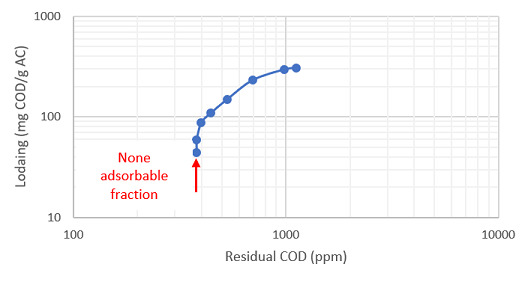
The isotherm showed that 380 ppm of the COD is non adsorbable so that treatment objective of 300 ppm COD cannot be reached with activated carbon treatment only. Further lab test work showed that a prefiltration step removed the suspended solids so that the treatment objective can be reached. Based on the lab results it was decided to install and additional filtration and an AquaFlow™ V20 H filled with 8 MT Resorb™ MC.
Leachate Reception Lagoon
↓
Hydro Cyclone
↓
Sand Filter
↓
AquaFlow™ V20 H with Resorb™ MC
↓
Slat Filter
↓
Storage lagoon
↓
Irrigation
The results of the COD removal of the site improved considerable to below treatment objective since the implementation of the new filtration step and the AquaFlow™ V20 H filled with 8 MT Resorb™ MC. The first filter run for more than 3 months resulting in a carbon consumption of approximately 0,9kg/m³.